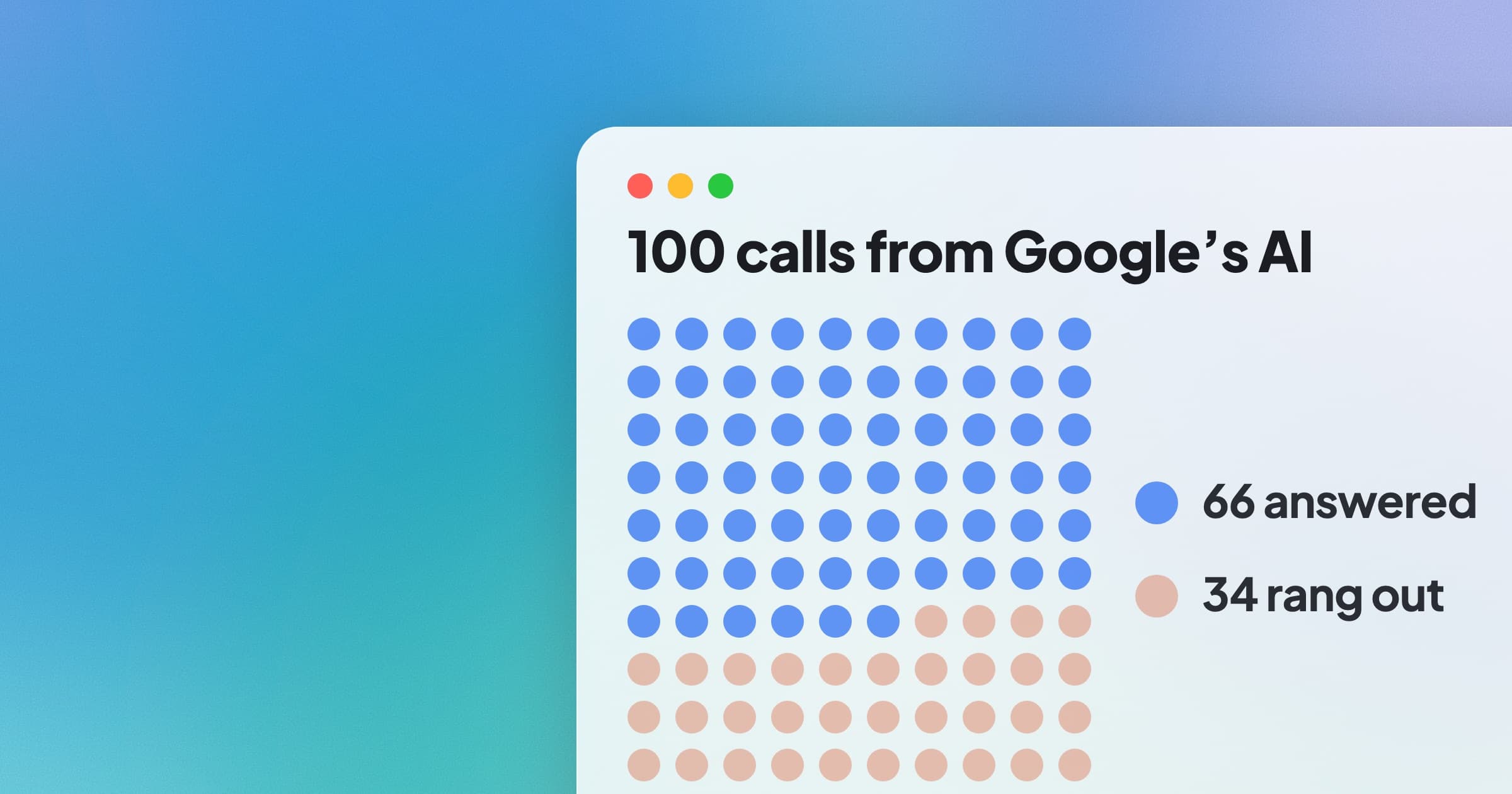
Google's AI is calling shops. Plumbers pick up 66% of the time.
ServiceFront · July 7, 2026
Google's Ask for Me phones local shops to check pricing for homeowners, and plumbers answer less than almost anyone. What's confirmed, and the one move to make.
A homeowner searches "plumber near me." Under the results sits an offer: have Google check pricing for you. They tap it, answer a few questions about the job, pick text or email, and go back to their day. Google's AI then phones the shops on the list, asks each one what the work costs and when someone could come out, and sends back a summary, promised within about 30 minutes.
That's Ask for Me, and it's been running for a while. Google launched it in Search Labs in January 2025 with two categories, nail salons and auto repair. By late 2025 it covered industries including plumbing, pest control, veterinary services, dry cleaners, and hair salons. These are real phone calls to real shop lines, and Google's Search product VP says the calls are clearly disclosed as automated calls from Google.
What the data says
In December 2025, the call-analytics company Invoca published numbers on how those calls actually go, tracked across its network from July 2025 through November:
- Pricing-request calls from Google's AI grew 324 percent in November over October. October had already grown 162 percent over September.
- Plumbing saw one of the sharpest climbs, with monthly call volume up more than 650 percent on average.
- Across all industries, 26 percent of the calls went unanswered. One in four.
- Plumbers answered 66 percent of theirs. Only veterinary clinics ranked lower, at 65. Auto repair shops answered 79 percent, pest control 75.
- Of the calls that were answered, 48 percent ended with no pricing shared.
Sit with what that means in practice. The caller is a machine with a real job attached, and it still can't reach a plumber a third of the time. It doesn't get frustrated and it doesn't hold a grudge. It records who picked up and what they said, and the homeowner gets a tidy summary built from exactly those calls. If your line rang out, you're not in it.
Why plumbers sit near the bottom
No mystery here. A solo plumber has no receptionist. The owner is the front desk, and at 2pm on a Tuesday the front desk is under a house with both hands on a pipe wrench. A 66 percent answer rate is what slammed looks like as a statistic. Wanting to pick up doesn't change the physics of wet hands in a crawl space.
The pricing gap is fair too. Nearly half the answered calls produced no number, and anyone who's quoted plumbing knows why: "depends on what we find when we open it up" is usually the honest answer, and a cold phone call is a bad place to give it. Quoting a repipe sight unseen is how you end up doing the job at a loss.
So plumbers aren't failing at this. The phone, as the only front door, is full.
What's confirmed and what's rumor
Confirmed: it's expanding. At I/O in May 2026, Google said that "for select categories like home repair, beauty or pet care, you can ask Google to call businesses on your behalf," and that these capabilities will roll out to everyone in the US this summer. The calls plumbers have been getting since mid-2025 were the early version. The everyone-in-the-country version is arriving now.
Also confirmed: you can opt out. Google Business Profile has a switch under advanced settings called "Google automated calls and text messages." Flip it and Google's AI stops calling you. It doesn't stop your competitors' phones from ringing.
Rumor: the "90-second rule" going around contractor marketing, the claim that you must answer within 90 seconds or the AI drops you. It traces back to SEO blogs, not to anything Google has published. So do most confident claims about how the AI decides which shops to call. Treat those as guesses sold as insight.
The move that's actually available
You can't answer more calls. That's the whole problem: the hands that would hold the phone are busy doing the work that pays for everything. What you do control is the written surfaces around your phone number, the ones that answer instantly whether or not you're free.
- Your website. The homeowner who sent Google to call is also comparing shops on a phone screen. A site that can answer "do you do tankless," "what does a water heater swap roughly run," and "can someone come today" is working while you're under the house. A site with a contact form and a photo gallery is not.
- The links on your Google Business Profile. Your profile points at your site and whatever quote page you've set up. That's where the tap-through lands, so make sure it lands on answers.
Here's where we sit in this, stated plainly: ServiceFront doesn't answer phone calls, and we won't pretend it does. A crowd of funded companies is already fighting over your phone line. What ServiceFront does today is the other half of the problem: paste your site's URL, verify the facts it finds, and it puts an agent on your own site that answers customers from those verified facts. No invented prices; if you haven't confirmed a number, it says it'll check. It flags the 2am emergency, captures the name, the number, and the job, and emails you the lead. The homeowner gets an answer while your hands are full, and the work waits in your inbox instead of going to whoever picked up first.
If you're curious what your own site can answer right now, paste your URL at servicefront.ai and ask it what your customers ask. The gaps show up fast.