Thumbtack math: the price you set and the price you pay
ServiceFront · August 18, 2026
Your Thumbtack lead price is exactly what you're charged, and it doubles as your bid for visibility. The formula that turns it into a real cost per booked job.
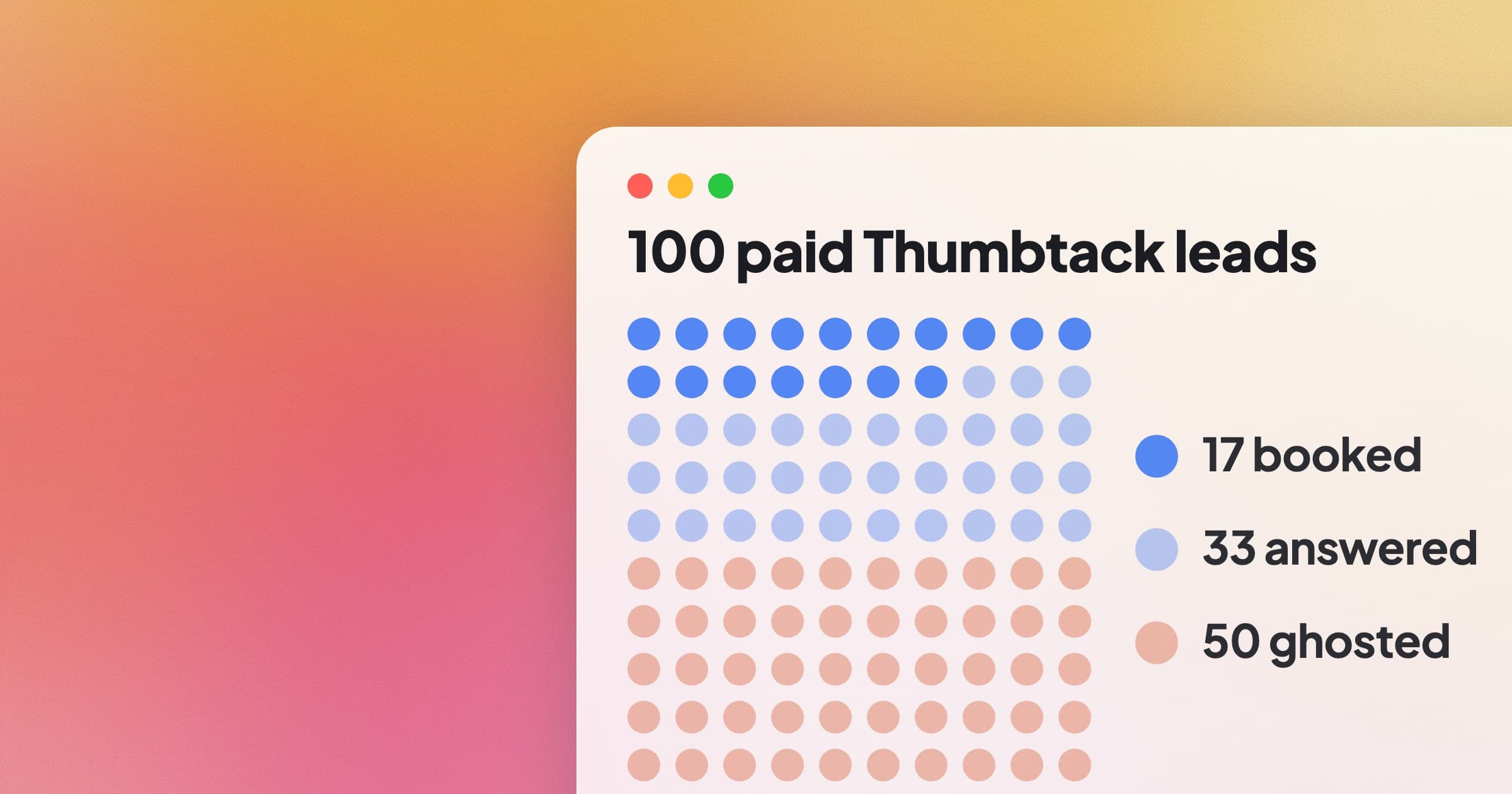
Ask a Thumbtack pro what a lead costs and you'll hear a number they picked themselves. That's the pitch. Thumbtack runs on exact lead prices: you set a price for every service you offer, and when a customer reaches out, that price is exactly what you're charged. No mystery invoice. After a decade of pay-per-lead platforms where the fee just happened to you, a slider feels like relief.
The slider is real. So is the sentence under it, in Thumbtack's own words: your lead prices "tell us which jobs are your top priority," and setting a higher price "makes you more competitive for those leads." The number you pick is a price and a bid at the same time. Turn it down and the leads thin out. So you control what a lead costs, Thumbtack controls how many leads that price deserves, and the only number that cuts through the middle is your cost per booked job.
We ran this exercise on Angi last month, and again on Yelp, which doesn't charge for leads at all. Same formula every time. Different traps. Picking between them is a different question.
Give Thumbtack its due first
There's a fair amount to credit, and pretending otherwise would make the rest of this less believable.
Exact prices beat opaque ones, full stop. A weekly budget hard-caps your total spend; once it's hit, the leads stop until next week. Opportunities, where you reach out to a customer who contacted other pros, only charge you if the customer responds. There's no annual membership fee, unlike the roughly $300 to $500 a year Angi charges. And Thumbtack's Quality Commitment puts numbers on the competition: a customer can contact at most five pros in the first four hours of their search, the count shows right on the lead, and every lead carries a verified phone number, with an invalid one being solid grounds for a refund request.
That last paragraph is the good news in full. Now the meter.
The meter runs on first contact
When a customer finds you in search and messages you, you auto-pay for the lead. Not when they answer your reply. Not when they're ready to hire. When they first reach out. A customer who sends one message and vanishes costs exactly what a customer who books a $4,000 job costs.
Read the refund policy with that in mind. The qualifying list covers real failures: the job changed significantly, the phone number is invalid, the lead is a duplicate, the date conflicts with your blocked calendar. What's not on the list is the lead who never answers again. And "the customer hired a different pro" gets an explicit no. Both of those land in your denominator, not your refund balance.
Three more mechanics worth knowing before you set that slider:
- Smart matching can charge you outside your preferences. Thumbtack's AI may send you leads beyond your usual job preferences when it predicts a fit. Decline one and tell them it wasn't a fit, and the refund is automatic. Credit where due, but it's on you to notice and decline.
- The floor moves. Thumbtack may adjust minimum lead prices, and if your prices sit at the minimum, they can rise automatically when the minimums do.
- Refunds are store credit by default. An approved refund goes to your Thumbtack balance, not your card, unless you ask within 10 business days. Close your account and whatever's left is gone; their terms make all fees final.
The formula
Same one as the Angi post, because the shape of the deal is the same:
Cost per booked job = lead price ÷ (response rate × close rate)
Three inputs, all from your own records:
- Lead price. Yours is whatever you set, minus refunds you actually won. That part Thumbtack genuinely made easier.
- Response rate. Pull your last 20 or 30 paid leads. How many answered your reply at all? You paid full price for the silent ones.
- Close rate. Of the conversations, how many became paid jobs?
Say your lead price is $60, half your leads answer you, and you close 1 in 3 of those conversations. That's $60 ÷ (0.5 × 0.33), about $364 per booked job. Every row below is illustrative; plug in your own numbers.
| Lead price | Response rate | Close rate | Cost per booked job |
|---|---|---|---|
| $30 | 70% | 50% | $86 |
| $60 | 50% | 33% | $364 |
| $91 | 40% | 25% | $910 |
Hold the output against the job, not the lead. $910 to win a $250 drain call is a donation. $364 for a water heater install that bills a few thousand can be a fine trade. For scale on the inputs: Thumbtack doesn't publish a rate card, but third-party trackers put most home-service trades at $25 to $75 a lead, plumbing repair at $30 to $65 with a $95 high end.
Two Thumbtack-specific reads on the formula:
Your close rate already carries the competition. Up to five pros can be talking to the same customer in the first four hours, each having paid their own lead price. The pros-contacted count shows on the lead; treat it as an input. A lead showing five pros deserves your fastest reply or a pass.
Work the formula backwards before touching the slider. Decide what a booked job is worth paying for in your trade, multiply by your measured rates, and that's the ceiling for your lead price. If Thumbtack stops sending leads at that price, the slider was never really yours; the market minimum for visibility is your true lead price, and now you know it.
What pros report
For the texture behind the inputs, here's a 2026 thread on r/Thumbtack. The poster, a multi-year pro, paid $91 for a lead, called the customer, and learned the project wasn't planned to start for another month. They could see at least two other pros on the same lead and figure Thumbtack collected around $270 on a job nobody could book yet. Their summary of the mechanic:
Multiple pros can be charged substantial amounts for the same lead regardless of the outcome.
A marketer in the same thread, running Thumbtack for a friend's cleaning business, on the shared-lead economics:
they charge him 50 bucks for a cleaning lead AND send this lead to 3 other people
Two posts from one thread, not a survey, and your own books outrank both. But "charged regardless of the outcome" is your response rate, and "sent to 3 other people" is your close rate, told as stories. The formula is just those stories with the emotion removed.
Renting demand, now inside ChatGPT, Claude, and Alexa+
When the math clears, remember what the fee buys: an introduction inside someone else's system. The customer's account, the project history, the review, all of it lives on Thumbtack. Next project, they open the app and the meter starts over.
And the meter is moving to where the questions are moving. Thumbtack partnered with OpenAI in October 2025 to build its app into ChatGPT on the Apps SDK, and landed in Anthropic's Claude in April 2026, on top of earlier work with Amazon's Alexa+ and OpenAI's Operator. A homeowner asks an AI assistant about a leaking water heater, and the assistant can now surface pros from Thumbtack's network of more than 300,000 businesses. Discovery moved into the chat window. The toll booth moved with it.
Our opinion, same as last month: renting discovery can be a rational trade while you're filling a schedule, and Thumbtack's version of the deal is more honest than most. Renting it as your only channel, at a price that doubles as a bid you can't lower without disappearing, is how the rent quietly becomes your biggest line item.
Own the surface you already have
Same disclosure as the Angi post: ServiceFront won't get you found on Thumbtack, Google, or ChatGPT. Discovery stays your problem, however you solve it. What we handle is the demand that already reaches your own site: the referral checking you out, the repeat customer, the homeowner comparing three quotes at 9pm. Today most of that traffic hits a dead contact form and leaves. ServiceFront puts an agent there that answers from facts you've verified (no invented prices, ever), flags the emergencies, captures the job details, and emails you the lead. No per-lead fee, no bid, no other pros on it.
If you want to see it on your own business, paste your URL into servicefront.ai and ask it what your customers ask you.