Yelp math: you're buying clicks, not leads
ServiceFront · August 22, 2026
Yelp is the one big home-services platform that doesn't charge per lead. It charges per click, which moves the risk to a number most contractors never measure.
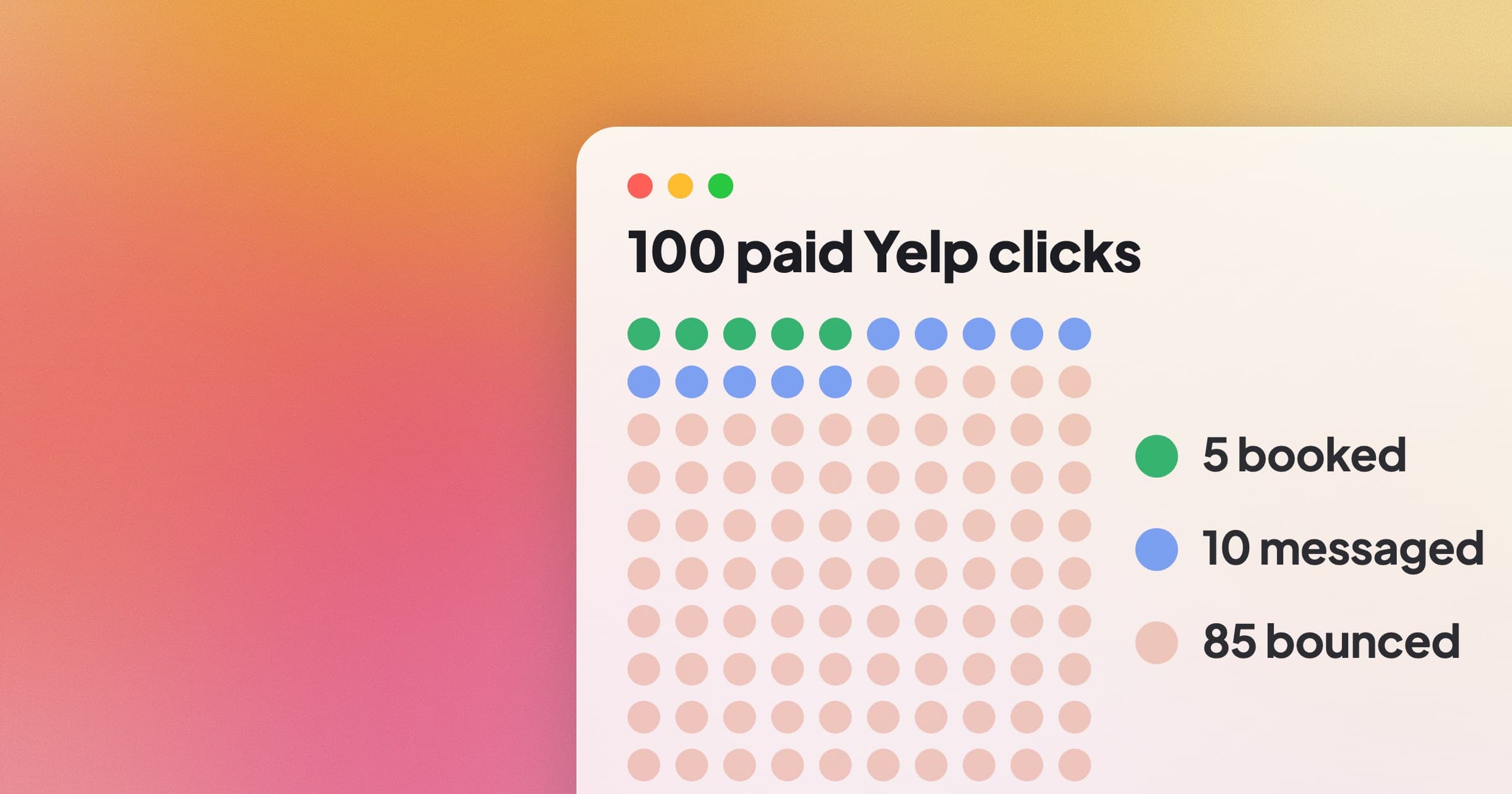
The last two of these posts had a lead fee sitting right there to divide. Angi charges you per lead at a price Angi picks. Thumbtack charges you per lead at a price you pick, which doubles as your bid. Yelp doesn't sell you leads at all.
That sounds like the better deal, and in one specific way it is. It also moves the risk to a number almost nobody measures, which is why "we tried Yelp and it didn't work" and "Yelp is our best channel" both get said with total confidence, often about the same trade in the same city.
Give Yelp its due first
The quote requests are free.
When a homeowner finds you on Yelp and asks for a price or your availability, that request lands in your inbox without a fee attached. Yelp's own guidance says Request a Quote is free to set up. No per-lead charge, no membership required to receive it, no credit spent to reply. Set against a platform that bills you $60 the moment a stranger types a message, that's a real structural advantage and it deserves to be said plainly before anything else.
There's a paid lead product too, and it's clearly separated. Nearby Jobs lets businesses "browse a feed of available jobs in their area for free, and they pay for the jobs they choose to respond to." You see the job first and decide. That's a better shape than paying for a lead you haven't read.
So where does the money go?
The meter runs on attention, not contact
Yelp Ads is a cost-per-click product. In Yelp's words: "Each time your ad is clicked, we will charge you according to your CPC price."
Three mechanics follow from that, and each one moves a decision away from you:
You don't set the cost per click. Yelp does, live. Per Yelp, "The cost per click is determined dynamically through an automated auction that is designed to optimize pricing based on the circumstances," and "You pay a different price per click depending on the supply and demand of that moment, which will depend on factors like how many other businesses like yours are competing for the same clicks, available ad inventory, and consumer interest." Thumbtack hands you a slider. Yelp hands you a market.
What you do set is the ceiling. Yelp "will never charge you more than the monthly budget you've set for your advertising spend." That cap is genuinely useful, and it's the one number fully under your control.
The spend isn't even. Yelp is explicit that "your ad will not be paced to spend your budget evenly each day of the month." So a slow week and a blown-out week can produce the same invoice, and reading daily spend as a signal will mislead you.
Put the platforms side by side and the difference is where the risk sits. Angi prices the lead. Thumbtack lets you price the lead and charges you for the privilege of being visible at that price. Yelp prices nothing you can see, auctions the attention, and caps your month.
The formula, with a worse denominator
Same question as always. What does a booked job cost?
Cost per booked job = cost per click ÷ (click-to-conversation rate × close rate)
The middle term is the one that's new, and it's the one that gets skipped. On Angi and Thumbtack, the fee attaches to a human being contacting you. Every paid lead is at least a person with a project. On Yelp, the charge attaches to a tap. Somebody saw your ad, tapped it, read your reviews, looked at three photos of a finished bathroom, and closed the tab. You paid for that. It was never a lead.
So the honest version of the math has an extra layer of leakage in it:
| Cost per click | Click to conversation | Close rate | Cost per booked job |
|---|---|---|---|
| $8 | 25% | 50% | $64 |
| $15 | 15% | 33% | $303 |
| $25 | 10% | 25% | $1,000 |
Every row is illustrative. The point is the spread: the same platform produces a $64 job and a $1,000 job depending on two rates that live on your profile, not in Yelp's dashboard.
For scale on the inputs, and as a warning about benchmarks: one 2026 breakdown for home-service contractors puts clicks at $5 to $25, leads at $30 to $150, and monthly spend at $500 to $5,000, with plumbing, HVAC, and roofing at the higher end. A WebFX guide published in August 2026 says flatly that there is no reliable average cost per click for Yelp Ads, lists Yelp Ads from $150 a month, and tells you to use Yelp's own category estimate instead of a benchmark from the internet. Both are trying to be helpful and they contradict each other, which tells you what any Yelp cost article is worth next to your own invoice.
Two reads worth taking from the shape of this:
Your profile is the conversion step you're paying for. On a per-lead platform, a weak profile costs you jobs. On Yelp, a weak profile costs you money directly, on every tap, whether or not anyone ever contacts you. Photos, review responses, hours, and service area stop being hygiene and start being the thing standing between your ad spend and your denominator.
Cap first, then measure up. The monthly budget is your only hard control, so start it small enough that a bad month is survivable, run it long enough to book something, and compute cost per booked job before you raise it. Yelp's own estimate is a starting guess, not a forecast.
The record, and what it actually says
Yelp comes with a story attached, and contractors repeat it to each other: they tank your reviews until you buy ads. It's worth knowing what's documented and what isn't, because the legend gets in the way of the arithmetic.
Documented: in 2014 the FTC released 2,046 complaints filed against Yelp, obtained under FOIA by the Wall Street Journal, and most of them reported that Yelp sales reps kept calling after being asked to stop. Sales pressure on small businesses is a real, recorded pattern.
Tested and rejected: the extortion theory itself. In Levitt v. Yelp, small business owners alleged Yelp extorted advertising payments by manipulating user reviews and penning negative ones. The Ninth Circuit affirmed the dismissal on September 2, 2014. Read the reasoning before you take it as a clean bill of health: the panel didn't find that Yelp behaved well, it found that the owners hadn't stated a claim, because "unless a person has a pre-existing right to be free of the threatened economic harm, threatening economic harm to induce a person to pay for a legitimate service is not extortion." On that standard the owners "failed sufficiently to allege that Yelp wrongfully threatened economic loss by manipulating user reviews," and separately "did not allege sufficient facts to support their claim that Yelp authored negative user reviews of their businesses."
The fair conclusion for an owner deciding where to put $800 a month: complaints are not findings, the strongest version of the accusation failed on a demanding legal standard rather than on the facts, and neither of those tells you whether Yelp Ads pay for themselves in your ZIP code. Only the formula does. This is the same discipline the Angi post asks for, where there was a real enforcement action: never take a number from a salesperson, and never take one from a forum either.
Renting attention, now inside ChatGPT
Here's the part that makes Yelp different from a plain ad buy, and it cuts both ways.
Yelp isn't only a destination anymore. It's becoming the local data layer other people's assistants answer from. On August 10, 2026 Yelp announced that Yelp Reservations and Waitlist now work inside ChatGPT, building on a content integration that was already "surfacing Yelp's trusted reviews, ratings, photos, and business details directly within the chat experience." In the same announcement Yelp describes the broader footprint: "platforms like ChatGPT, Apple Maps, Amazon's Alexa+, Microsoft Bing, DuckDuckGo, Yahoo!, leading automotive brands, and more, are delivering Yelp-powered recommendations and helping people make reservations, join a waitlist and request quotes."
On Yelp's own surface, the Yelp Assistant shipped in April 2026 lets a homeowner describe a job in plain language and request a quote across more than 450 categories, with a Calendly integration that puts a "Book now" button in front of them.
The upside for a contractor is real: a well-kept Yelp profile is now working inside assistants you never signed up for. The catch is the same one as the other two platforms, in a new coat. The profile earning those recommendations is on Yelp's land. The reviews are Yelp's reviews. The homeowner's next project starts in an assistant that reads Yelp, and your visibility inside it is still shaped by an auction you don't set the price in.
Our opinion, third month running: renting discovery is a defensible trade while you're filling a schedule, and Yelp's version has the least offensive lead economics of the three. What none of them will ever sell you is the customer who already knows your name.
Own the surface you already have
Same disclosure as the other two posts. ServiceFront won't get you found on Yelp, Google, or ChatGPT. Discovery stays your problem, however you solve it. What we handle is the demand that already reaches your own site: the referral checking you out, the repeat customer, the homeowner comparing three quotes at 9pm. Today most of that traffic hits a dead contact form and leaves. ServiceFront puts an agent there that answers from facts you've verified (no invented prices, ever), flags the emergencies, captures the job details, and emails you the lead. No click charge, no auction, no second pro on it.
If you want to see it on your own business, paste your URL into servicefront.ai and ask it what your customers ask you.
Questions people ask
Does Yelp charge contractors per lead?
No. Quote requests that come through your Yelp profile don't carry a per-lead fee the way Angi and Thumbtack leads do, and Yelp says Request a Quote is free to set up. What Yelp charges for is advertising, billed per click, plus Nearby Jobs, where you browse a feed for free and pay for the jobs you choose to respond to.
How much does a Yelp click cost a contractor?
Yelp doesn't publish a rate card, and third-party trackers disagree enough that you shouldn't trust any single number. One 2026 breakdown puts home-services clicks at $5 to $25; another says outright that there's no reliable average cost per click for Yelp Ads. Yelp prices each click through an automated auction, so your market and trade decide it. Use Yelp's own estimate for your category, then check it against your invoice.
Can I set my own cost per click on Yelp?
No. Yelp determines the cost per click dynamically through an automated auction based on supply and demand, competing businesses, and available inventory. What you set is the monthly budget, and Yelp says it will never charge you more than that. Your ad spend also isn't paced evenly across the month.
Is Yelp cheaper than Angi or Thumbtack for contractors?
It depends on what happens after the click, and the platforms aren't comparable on their sticker prices. Angi and Thumbtack charge when a person contacts you. Yelp charges when a person taps your listing, and some of those people never message you at all. The only comparable number is cost per booked job, which you have to compute per platform from your own books.
Did Yelp get sued for manipulating reviews to sell ads?
Yes, and the claim failed. In Levitt v. Yelp, small business owners alleged Yelp extorted advertising payments by manipulating user reviews and penning negative ones. The Ninth Circuit affirmed dismissal on September 2, 2014, on the ground that they had not stated a claim: under the governing standard, threatening economic harm to induce someone to pay for a legitimate service is not extortion unless they had a pre-existing right to be free of that harm. The panel also found they had not alleged sufficient facts that Yelp authored negative reviews of their businesses. Separately, the FTC disclosed 2,046 complaints about Yelp in 2014, most about sales reps calling after being asked to stop. Complaints are not findings, and a dismissal on the pleadings is not a finding that nothing happened.