LSA math: what a Google Local Services lead costs you
ServiceFront · November 2, 2026 · Updated November 12, 2026
Google Local Services Ads charge per lead, and since October 1 a missed call that rings past 20 seconds counts as one. The ranges by trade, the credit rules, and the cost per booked job.
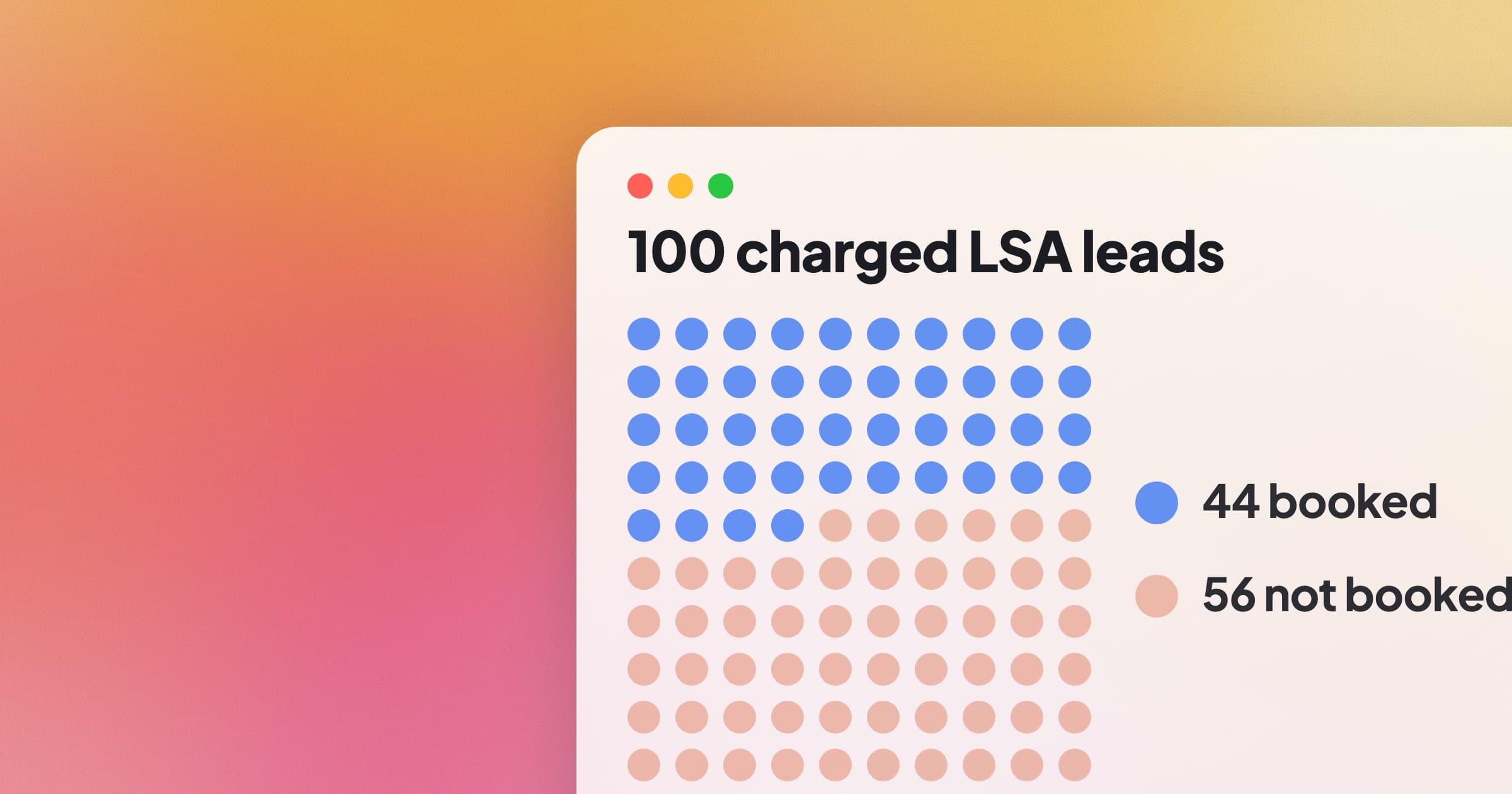
The last three posts in this series worked out what Angi, Thumbtack and Yelp actually charge for a customer. Google's version has been sitting at the top of the results page the whole time, above the paid ads and the organic listings: Local Services Ads, or LSA to anyone who has run them. It's the one lead channel that is Google-native, and the one we hadn't done the math on.
It's also the one that's changed the most lately. The badge contractors spent years earning got retired. The dispute flow gave way to automated credits. On October 1, 2026, a phone call you didn't pick up started costing money. And the whole product is being folded into Google Ads. So the arithmetic below comes with more footnotes than usual, and most of them are Google's own words.
What are Local Services Ads?
In plain words: they're the ads at the very top of Google when someone searches for a trade near them, like "plumber near me." They sit above the regular paid ads and the organic listings, and a homeowner can call you, send you a message or book a time straight from the ad, without having to visit your website.
Here's what sets them apart from Google's other ads:
- You pay when someone contacts you, not when they click. A call, a message or a booking request counts as a lead, and you're billed for each one Google rates as valid.
- Google checks your business first. The Google Verified badge tells homeowners your business "has passed Google’s proprietary screening process."
- There are no keywords to pick. You choose your service categories and the areas you cover, and Google targets your ad from those.
- Only some trades qualify. Google offers them "only for certain service categories," and plumbers, electricians, HVAC and roofers are all on the US list.
One change is underway. Since August 2026, Google has been moving these ads into its main Google Ads platform, starting with select US home-service advertisers, under the name Performance Max campaigns with pay-per-lead goals. You still pay per lead, and the ads still show only on Google Search and Google Maps. What goes away is the option to set a maximum price per lead, which we get to below.
Give LSA its due first
You pay per lead, not per click. Google's description of the deal opens with it: "With Local Services Ads, you pay for valid leads." A homeowner who taps your ad, reads your reviews and leaves costs you nothing, which is the exact leak the Yelp post is about. The meter runs when someone contacts you.
The badge does real work. To carry it, a new advertiser has to "successfully complete the Local Services screening and verification process," which is why the ads sit where they sit: above the paid search ads and the organic listings, with your rating and review count on the ad itself.
Three more mechanics deserve credit before the catches:
- Bad leads are filtered before the charge. Google says "Leads are first assessed when the potential customer makes initial contact, and leads determined to be invalid or low quality are not charged."
- Repeat contact is free for two weeks. Once a lead is charged, follow-ups from the same customer aren't charged again "provided there is interaction within 15 days and the contact comes from the same phone number or email address."
- Messages usually cost less than calls. Per Google, "Message leads are typically priced lower than the corresponding phone lead price, although that’s not always the case."
Nothing in Google's own description of the charges is a membership fee or a setup fee, which the Angi post couldn't say. That's the good news in full.
What counts as a lead, including the call you missed
Here's Google's list of valid leads, lightly condensed. You're charged when:
- you answer a call, or call the customer back and speak with them;
- you receive a text message or email from the customer;
- you receive a voicemail;
- you receive a booking request (US and Canada only);
- or "You missed a phone call during your business hours and the customer stays on the line for more than 20 seconds."
That last line is new. Google told advertisers in August, in a notice Search Engine Roundtable published on August 25, 2026: "On October 01, 2026, we are updating how and when you are charged for call leads originating from Local Services Ads," and "Missed calls during business hours will now be charged as valid leads". The help page now spells out the edges. Voicemail counts: a call that reaches "voicemail or an automated greeting during your business hours" is treated as a connected call and charged after 20 seconds "whether or not they leave a message." A phone menu buys you a reprieve: the timer only starts when the caller presses a key, and "You won't be charged if customers don't press a key to get routed." Business hours are whatever your Google Business Profile says they are.
Read that against the other platforms. On Angi and Thumbtack, the ghost costs you: a homeowner who contacts you and vanishes is a full-price lead. On LSA, you can be the ghost. Your phone rings under a house for 21 seconds, nobody picks up, nobody calls back, and the lead is charged.
Credits replaced disputes
Contractors used to dispute LSA leads one by one. That flow is gone, and the help page that described it now redirects to the automated credits page. The current rules, in Google's words:
- "Charged leads get reassessed by our models over time, and may be issued credits automatically if later determined to be low quality." The window is "a 30-day period."
- "Google no longer supports credits for “job type not serviced” and “geo not serviced” leads." Those are exactly the leads a loose service-area or job-type setting generates, so the fix is on your side of the dashboard now.
- "In most cases, credits will be applied to your account balance within 30 days. Note that the original lead charge will still appear on your invoice."
- You can rate a lead in the feedback survey, and Google says "We may also occasionally credit leads you report as poor quality through this survey." Occasionally is the operative word.
- "Lead credits aren't available for health care verticals, tax specialists, or advertisers in EMEA."
Two consequences for the formula. Your lead price is whatever the invoice says minus the credits that actually landed, and both halves of that are decided by Google's models on Google's schedule. And the one lever you still hold, narrowing your service area and job types, comes with Google's own warning that it "may reduce overall lead volume."
The badge changed under you
For years the pitch was the badge: Google Guaranteed, Google Screened, and a Money Back Guarantee behind the first. On August 20, 2025 Google announced that "Starting in October, we'll be unifying all Local Services Ads (LSA) badges" into one Google Verified badge, replacing "Google Guaranteed, Google Screened," "License Verified by Google and the Money Back Guarantee."
The help page is blunter about the money: "As part of this change, Google will be discontinuing the Money Back Guarantee associated with the Google Guarantee badge." Customers could still claim for services booked through LSA before December 7, 2025, within 30 days of the job. After that, the promise is gone. Google also says "Local Services Ads ranking won't be affected by this change."
What it means for the math: the badge still says checked, and that's worth something on a results page. It no longer says backed. If your truck, website or sales pitch still says Google Guaranteed, it's describing a program that ended in 2025.
Ranking is an auction with a quality score
Google is unusually direct about how the ads are ordered. "All provider listings in Local Services are displayed and ranked based on an auction, where the highest ranked ads show first." The inputs it names:
- Your bid. "The amount you bid is the maximum amount you're willing to pay for a lead, though you may end up paying less."
- Responsiveness. "Your responsiveness to customer inquiries and requests: Missed calls may negatively affect your responsiveness." So a missed call is now a charge, and by Google's own account it may cost you rank as well.
- Profile quality. "Your rating, number of reviews, average response time, use of high-quality images, the verification checks you have completed," and the kicker: "Higher quality profiles, including those with images, may rank higher and may also pay lower costs per lead."
The bidding page adds the line that governs the price: "When similar local businesses bid on the same lead, those bids determine how much the lead is worth." Three modes exist today. "Maximize leads" lets Google set the bid, and Google says providers who use it "typically get more leads than those who don’t." "Target cost per lead" sets a price that is "around the average you’ll pay for leads." "Max per lead" is a manual ceiling.
The budget side is a weekly target with a monthly cap. "Your average weekly budget is your target spend," and "In some weeks you may spend less than your average weekly budget, and in others you may exceed it based on demand for your business." The hard line is the month: "The exact formula for the monthly max is average weekly budget x 30.4 ÷ 7." Once you hit it, your ad stops showing until the month turns.
Then the floor moves. Since August 2026, Google has been migrating LSA accounts into Google Ads as Performance Max campaigns with pay-per-lead goals, starting with "select home and storefront service advertisers in the United States (including plumbing, HVAC, electrical, appliance repair, house cleaning, lawn care, roofing, pest control, and moving)", then broader groups including service-area businesses in late 2026, then non-US accounts and the remaining categories in 2027. Billing stays per lead and the ads stay on Search and Maps. What goes: "Manual bidding (such as setting a maximum cost-per-lead) is no longer supported in Google Ads." Your weekly budget becomes a daily one (the weekly figure divided by 7) and the monthly cap stays the same. And the history you'd need for the formula below walks out the door: "Your Local Services Ads performance reports won't transition to Google Ads." Download them before your migration date. Google says it emails the account administrator 14 days ahead.
Set the five platforms side by side and LSA's shape is: an auction prices the lead, you could cap it, and the cap is going away.
What a lead costs, by trade
Google doesn't publish a rate card, so the numbers come from vendors that can see a lot of accounts. Here's what's out there, with the sample behind each figure, because the sample is the story.
| Source | Period | Sample | Cost per lead |
|---|---|---|---|
| SearchLight benchmark | Feb 2026 | 888 contractors, 126,650 leads, $6.72M spend | $53 blended. Electrical $39, HVAC $51, plumbing $57, drain/sewer $59 |
| The Data-Driven Trades | May 2026 | 1,011 businesses on the SearchLight platform | $63.29 per unique lead. Plumbing $69.26, electrical $49.02 |
| The Data-Driven Trades | Sep 2026 | The same 837 contractors tracked June through September (948 in the full month) | $62.88 per unique lead for the cohort, down from $65.70 in August. Plumbing $67.05, HVAC $60.66 |
| WordStream | Updated Aug 2026 | Not stated | About $60 |
| 99 Calls estimator | Rolling 3 months, checked Nov 12, 2026 | 6 plumbing sites, 12 roofing | Plumbing $85.12 average, roofing $112.38 |
Four things to know before you borrow any of these:
Two of the big numbers are one data set. The Data-Driven Trades newsletter says outright that its May figure is from businesses "on the SearchLight platform." So $53 in February and $63.29 in May aren't two sources agreeing. They're the same attribution vendor's customers in different months. That's still the best public data on LSA, but it's one window, not three.
Spend moves the price. In the September data, contractors spending under $2,000 a month paid $42.73 a lead and contractors over $50,000 a month paid $75.84. In that sample, the bigger the budget, the more each lead cost.
Small trade samples wobble. The newsletter flags its own $49.02 electrical figure: "with only 21 accounts in the sample, that number is more directional than definitive." The 99 Calls calculator, which is the page you'll land on if you search for one, is built on "charged-lead data from 99 Calls Google Local Services Ads (LSA) client campaigns over the last 3 months" and shows a handful of sites per trade. Its plumbing number was $85.12 the day we looked and will be something else the day you do.
Book rates cluster. SearchLight reports "The average book rate on LSA leads is 43.9%." The newsletter's raw figure was 40.9% in May and 41.8% in September for its four-month cohort. Call it two in five, and remember those are contractors who pay for software to track their marketing, which isn't a random sample.
The formula
Same one as the other three posts, with the middle term adjusted for a platform that charges you for your own missed calls:
Cost per booked job = lead price ÷ (reach rate × close rate)
- Lead price. Your average charged lead from the Leads page, after the credits that actually landed. Not a benchmark.
- Reach rate. Of your charged leads, how many did you actually talk to? Since October that denominator includes the 21-second ring nobody returned, the voicemail that never called back, and the message lead that went silent.
- Close rate. Of the conversations, how many became paid jobs?
Say a lead runs $57, you reach 7 in 10, and you close 45% of those. That's $57 ÷ (0.7 × 0.45), about $181 per booked job. Every row below is illustrative. Plug in yours.
| Lead price | Reach rate | Close rate | Cost per booked job |
|---|---|---|---|
| $39 | 80% | 55% | $89 |
| $57 | 70% | 45% | $181 |
| $85 | 50% | 30% | $567 |
Now hold it against the job. $567 to win a $250 drain call is a loss on every single one. $181 for a water heater install that bills a few thousand is a fine trade. Same ad, same badge, opposite verdicts, which is why the only honest answer to "is LSA worth it" is per trade and per job type.
One more read, straight from the benchmark. SearchLight's $53 lead at a 43.9% book rate works out to about $121 per booked lead. The same page reports "The average cost per paying customer is $233." Those two figures measure different outcomes, booked versus paid, and they're not interchangeable. The second one is the one that pays your truck note. Use it.
Google's AI is already on your phone line
Here's the part that makes LSA different from the other three, and it runs through the phone.
We wrote in July 2026 about Ask for Me, Google's AI that phones local shops to check pricing for a homeowner. Invoca's call data put plumbers near the bottom: they answered 66 percent of those calls, and across every industry one call in four went unanswered. The reason was never laziness. The person who'd pick up is under a house.
LSA has now put a price on that same ring. During business hours, a call that rings past 20 seconds is a charged lead, and Google's ranking page says missed calls "may negatively affect your responsiveness." Whether a call Google's own AI places to your LSA number is billed as a lead is something Google doesn't say, and we won't guess. What's documented is enough: on this channel the phone is the expensive surface, and the shops that can't answer it pay on the invoice and, by Google's own account, may pay again in the auction.
You can't grow a third hand. What you can do is make sure the written surfaces around your number carry the answers, so the homeowner whose assistant couldn't reach you still finds "yes, we do tankless" and "a water heater swap usually runs about this" on the page they tap through to. Your Business Profile is one of those surfaces. Your website is the other.
Renting demand, Google-native edition
On ownership, LSA is the best-behaved of the four we've taken apart. Your reviews live on your Google Business Profile, and when the lead is a call, the homeowner dialed you, not an app. Compared with a platform that keeps the customer's account, project history and review on its own servers, that's a real difference, and it's why we'd run LSA before Angi, Thumbtack or Yelp if we were filling a schedule.
It's still rent. Google routes message leads "through anonymized proxy numbers and email aliases," records the calls, and prices each lead partly on "Whether the customer has contacted other Local Services advertisers." The next project still starts with a search, and the auction still decides who the homeowner sees first. The badge, the missed-call rule and the bidding controls all changed in about a year, and the dispute flow before that.
Our opinion, fourth post running: paying for discovery is a defensible trade while you're filling a schedule, and LSA is the version of that trade we'd pick. What it will never sell you is the customer who already has your number.
Own the surface you already have
Same disclosure as the other three posts. ServiceFront won't get you found on Google, and it doesn't answer your phone. Discovery stays your problem, however you solve it, and a crowd of funded companies is already fighting over your phone line. What we handle is the demand that already reaches your own site: the referral checking you out, the repeat customer, the homeowner comparing three quotes at 9pm, the one whose assistant couldn't get you on the phone and tapped through to your website instead. In our experience most of that traffic hits a dead contact form and leaves. ServiceFront puts a front desk there that answers from facts you've verified (no invented prices, ever), flags the emergencies, captures the job details, and emails you the lead. No per-lead fee, no auction, no 20-second clock.
If you want to see it on your own business, paste your URL into servicefront.ai and ask it what your customers ask you.
Questions people ask
What are Local Services Ads?
They're Google's pay-per-lead ads for local trades. They sit at the very top of a Google search like 'plumber near me', above the regular paid ads and the organic results, and a homeowner can call you, send a message or book a time straight from the ad without having to visit your website. You pay for each valid lead, not for clicks. There are no keywords to pick: you choose your service categories and the areas you cover, and the Google Verified badge shows the business passed Google's screening. Since August 2026 Google has been moving them into Google Ads as Performance Max campaigns with pay-per-lead goals, starting with select US home-service advertisers. They still show only on Google Search and Google Maps.
How much do Google Local Services Ads cost?
There's no rate card. You pay per valid lead, and Google says the price varies by your location, the job type, the type of lead and your bidding mode. You set an average weekly budget, and Google caps the month at that weekly figure times 30.4 divided by 7. For scale, the largest 2026 benchmark put the blended cost at $53 per lead across 888 home-services contractors in February, and a four-month cohort of 837 contractors from the same data pool ran $62.88 per unique lead in September. A WordStream guide updated in August 2026 says about $60.
What is the cost per lead for Local Services Ads by trade?
In SearchLight's February 2026 benchmark, electrical ran $39 a lead, HVAC $51, plumbing $57 and drain or sewer work $59. By September 2026 the same platform's data had plumbing at $67.05 and HVAC at $60.66. Spend changes the number too: contractors under $2,000 a month paid $42.73 a lead and those over $50,000 a month paid $75.84. Treat every figure as orientation. Your own Leads page is the only price that's true for your trade and market.
What counts as a lead on Local Services Ads?
Google charges for a call you answer or return, a text or email, a voicemail, a booking request, and, since October 1, 2026, a call you miss during business hours if the caller stays on the line for more than 20 seconds. A call that goes to voicemail during business hours is treated as connected and charged after 20 seconds whether or not they leave a message. Follow-ups from the same customer within 15 days aren't charged again. Invalid and low-quality leads aren't charged in the first place.
Can you dispute a Local Services Ads lead?
Not the way you used to. Google assesses every lead when it arrives, skips the charge on invalid or low-quality ones, and reassesses charged leads over 30 days, crediting automatically if its models decide the lead was poor. You can rate a lead in the feedback survey, and Google says it may occasionally credit leads reported that way. Credits for a job type you don't do or an area you don't serve are no longer offered, and credits aren't available for health care, tax specialists or advertisers in EMEA.
Is Google Guaranteed still a thing?
No. In October 2025 Google replaced the Google Guaranteed, Google Screened and License Verified badges with a single Google Verified badge. The Money Back Guarantee that came with Google Guaranteed was discontinued; customers could claim only for services booked before December 7, 2025, within 30 days of the job. Google says the badge change doesn't affect how the ads rank.